Modulation of Summer Squash Growth and Productivity Via Spiritual Blessings (Biofield) Energy Treatment (SBET)

Abstract
Background
The increasing demand for sustainable and eco-friendly agricultural practices has led to the exploration of non-traditional methods to enhance crop yield and resilience. Spiritual Blessings (Biofield) Energy Treatment (SBET), a form of consciousness-driven energy healing, is increasingly being investigated for its potential to modulate biological systems at the cellular and molecular levels without use of chemical additives
Objective
This study aimed to evaluate the impact of SBET on the growth characteristics and overall productivity of summer squash (Cucurbita pepo L.).
Methods
The study was conducted using a controlled experimental design, where seeds and plots were divided into two groups: control and treated. The treated group received a remote SBET by a recognized practitioner, while the control group remained untreated. Both groups were maintained under identical environmental conditions (soil, water). Parameters such as germination rate, plant height, leaf area index, and total fruit yield were monitored over a full growth cycle.
Results
Results showed that plant height, number of branches, and total number of leaves per plant were significantly improved by 35.14% (p ≤ 0.001), 41.64% (p = 0.011), and 49.01% (p = 0.029), respectively, in the treatment group compared to the control group. Additionally, fruit length and total fruit yield (tons per hectare) were significantly increased by 39.68% (p = 0.002) and 15.92%, respectively, in the treatment group compared to the control group.
Conclusion
Exposure of SBET significantly improved both vegetative and reproductive development, yielding substantial increases in plant height, branching, and leaf production.
Article Information
- Received
- Accepted
- Published
Academic Editor: Anubha Bajaj, Consultant Histopathologist, A.B. Diagnostics, Delhi, India
Checked for plagiarism: Yes
Review by: Single-blind
Copyright © 2026 Dahryn Trivedi, et al.
 This is an open-access article distributed under the terms of the Creative Commons Attribution License, which permits unrestricted use, distribution, and reproduction in any medium, provided the original author and source are credited.
Corresponding author: Snehasis Jana, Trivedi Science Research Laboratory, Pvt, Ltd., Research and Development, Thane (W), Maharashtra, India —
Competing Interests
Author DT was employed by Trivedi Global, Inc. VDK, NRP, and TBG were employed by Shree Angarsiddha Shikshan Prasarak Mandal’s College of Agriculture, Sangulwadi, Mohitewadi, Maharashtra, India.Authors SM and SJ were employed by Trivedi Science Research Laboratory Pvt. Ltd.
Funding
The authors declare that no funds, grants, or other support were received during the preparation of this manuscript.
Data Availability
No data-availability statement was provided by the authors.
Acknowledgements
The authors are grateful to Divine Connection Foundation for the assistance and support during the work.
Citation:
Introduction
Summer squash (Cucurbita pepo L.) is a high-value vegetable crop of global economic importance, for its rapid growth cycle and high nutritional density, particularly its abundance of vitamins A and C, fiber, and essential minerals. In regions such as South Asia, it serves as a critical component of food security and household income for smallholder farmers. However, the productivity of C. pepo is increasingly threatened by soil degradation, imbalanced nutrient management, and environmental stressors associated with climate change 1. While synthetic fertilizers have historically bridged the yield gap, their long-term application was linked to reduced microbial diversity, deteriorating soil structure, and significant environmental contamination 2. Consequently, there is an urgent need for sustainable, non-chemical alternatives that can modulate plant physiology and enhance productivity without ecological harm.
Emerging research into "biofield" energy, the endogenous electromagnetic and subtle energy fields associated with living organisms, suggests a novel paradigm for agricultural enhancement. Spiritual Blessings (Biofield) Energy Treatment (SBET) involves the application of focused intention or "universal life force" to biological targets. Recent studies have explored these non-pharmacological interventions, finding that intentionality-based energy can significantly influence cellular processes, gene expression, and overall plant vigor. For instance, controlled experiments have demonstrated that such subtle energy fields can modulate plant growth and the structural properties of biological systems, potentially acting as a "cognitive fertilizer" to improve resilience 3. The efficacy of similar energy-based protocols, such as "Pranic Agriculture," has been rigorously documented across various crops. Research indicates that the application of these subtle energy treatments can lead to enhanced canopy architecture, increased chlorophyll content, and superior yield parameters. Specifically, field trials on other high-value crops have shown that energy modulation can significantly improve vegetative growth and fruit quality through mechanisms that likely involve altered metabolic signaling and metal ion uptake 4. Furthermore, recent findings regarding "Consciousness Fields" suggest that these information-based energy treatments can mitigate severe environmental stressors, such as drought, by improving germination rates and biochemical responses in staple crops 5.
Despite these promising results in other species, the specific impact of Spiritual Blessings (Biofield) Energy Treatment (SBET) on the growth dynamics and productivity of Cucurbita pepo remains underexplored. This study aims to fill this gap by evaluating the morphological, phenological, and yield-related parameters of Summer Squash following SBET. By investigating the potential for subtle energy to modulate crop performance, this research contributes to the development of a holistic, sustainable framework for modern agriculture.
Materials and Methods
Study site details
Research trials were executed at Bhandarwadi (Sindhudurg), a site within the Konkan agro-climatic zone, Maharashtra, India (15°37’–16°40’ N, 73°19’–74°13’ E; elevation 26 m). The climate features elevated in summer thermal regimes and temperate winters, where temperatures reach 40 to 42°C during the pre-monsoon phase. Erratic precipitation patterns frequently induce severe moisture stress, which may impair critical plant physiological functions during various ontogenetic stages of crop development and yield formation under these specific tropical coastal maritime conditions.
Seed details and experimental design
Summer squash/green zucchini (Cucurbita pepo L. cv. Sunny House-Hybrid) seeds (genetic purity: 95%; Lot No: NUP-48962595; Label: 03001) were obtained from Namdeo Umaji Agritech (India) Pvt. Ltd. The specimens were categorized into two experimental cohorts: (i) an untreated control group (CONGZUG) and (ii) a biofield energy treated group (BTGZUG) subjected to Spiritual Blessing (Biofield) Energy Treatment (SBET/prayers). To isolate the specific effects of SBET, identical agronomic protocols for irrigation, fertilization, and pest management were maintained uniformly across both the experimental groups for the entire duration of this study.
Field layout
Trials were arranged following a Randomized Complete Block Design (RCBD) evaluating two distinct primary treatments. The field site was partitioned into three blocks. Treatments were assigned to blocks randomly, ensuring robust allocation within each experimental replication cycle. Six experimental units were established, with each plot measuring 4.0 m × 2.0 m (8.0 m2). Spacing was fixed at 1.0 × 1.0 m, with maintained one-meter buffers between replicates and 0.5 m between individual experimental plots, encompassing a total study area of 60.0 m2 and an individual unit area of 8.0 m2 for each replicate. Thorough site clearance preceded all activities. Standard fertilizer (50, 100, and 50 kg NPK ha-1) was applied directly to every plot and incorporated into the soil prior to sowing, ensuring optimal nutrient availability.
Spiritual energy treatment (blessing/prayer) strategy
The control samples (CONGZUG) comprised untreated green zucchini seeds and soil substrate. The experimental group (BTGZUG) underwent a non-physical biofield energy protocol, administered by an expert practitioner, Dahryn Trivedi, who possesses more than 12 years of professional experience. This intervention was applied for 4 minutes at a distance of approximately 0.5 meters (1.5 ft) from the samples. Ambient parameters were maintained at a constant temperature of 28 ± 2°C and a relative humidity of 65 ± 5%. To maintain sample integrity, no physical contact was permitted throughout the entire experimental procedure. The protocol utilized a standardized "laying on of hands" technique, designed to modulate the energetic state of the agricultural matrix and seeds. All specimens were subsequently managed using standard cultivation practices to assess specific phenotypic and physiological variations.
Soil properties
Before trial commencement, composite topsoil was harvested from the 30 cm profile of each plot via an established five-point sampling methodological framework. Specimens were ambient-dried, screened through 2-mm mesh, and subsequently refrigerated at 4 °C pending physicochemical characterization. Textural class was classified through the qualitative feel technique 6, while pH was potentiometrically quantified in 1:2 (w/v) soil–water aqueous suspensions utilizing a pre-calibrated electrode assembly ensuring precision.
Seed plantation and management
Seeds were directly sown into the soil; moisture was maintained via manual irrigation during the initial one week following sowing. Subsequently, irrigation was regulated using a drip system comprising self-compensating emitters (0.5 m spacing; 3 L/h discharge flow rate). Basal fertilization comprised 50:100:50 kg/ha N:P:K, delivered via urea, single superphosphate (SSP), and muriate of potash (MOP) nutrient sources. The entire amounts of SSP and MOP, plus 50% urea, were incorporated pre-sowing; the residual nitrogen was then side-dressed at day 21 following initial sowing. To mitigate pest pressure, chlorpyrifos 50% + cypermethrin 5% (Hamla 550; Gharda Chemicals Ltd., India) was administered at a 2 mL/L concentration throughout each respective treatment.
Plant growth parameters
To evaluate morpho-physiological parameters, five zucchini plants were randomly sampled from each experimental plot. Qualitative attributes assessed included leaf blade dimensions, morphology, margins, and pigmentation, alongside lobe frequency, floral colour, fruit shape, exocarp colour, mesocarp pigmentation, and rind characteristics. Seed colour, size, and shape were also documented. Quantitative traits encompassed plant height (cm), canopy spread (cm), primary branch and node counts, leaf density, and blade dimensions (cm). Phenological and yield metrics included days to 50% anthesis, fruit mass (g), length (cm), and equatorial diameter (cm). Furthermore, fruit frequency per plant, total yield (t/ha), and seed dimensions (length and width in cm) were meticulously quantified to provide a robust characterisation of the green zucchini genotypes during the growth period.
Yield parameters
The green zucchini (C. pepo) fruits were harvested upon reaching physiological maturity. Morphometric dimensions, including length and diameter, were quantified via digital calipers, while individual fresh mass was determined using a precision electronic balance. To assess cumulative productivity, five plants were randomly selected from each net plot. Total yields were recorded in kilograms and subsequently converted into tonnes per hectare (t/ha) to facilitate standardized yield extrapolation.
Data analysis
Data are presented as mean ± standard error of the mean (SEM). Intergroup comparisons were evaluated using unpaired Student’s t-tests within the SigmaPlot (v14.0) environment. Statistical significance was defined as p < 0.05.
Results
Soil properties analysis
Baseline characterization of the experimental soil across all plots identified a sandy loam texture with a strongly acidic profile (pH 5.01). This acidity correlated with restricted cation exchange capacity (CEC) and suboptimal nutrient bioavailability. Post-harvest analysis demonstrated that plots subjected to SBET exhibited a significant pH shift to 5.90, transitioning the classification from strongly to moderately acidic (data not shown). These data suggest that the intervention modulates soil chemical properties, potentially by enhancing buffering capacity or altering ionic concentrations within the soil matrix, thereby mitigating the constraints associated with extreme pedological acidity.
Morphology of green zucchini plants
The morphological development of the green zucchini was documented through systematic observations at set intervals. This study tracked from the initial germination, seedling phase vegetative growth stage, floral phase, fruit growth stage, and final harvest stage (Figure 1).
Figure 1. Representative images illustrated the changes in vegetative growth characteristics of green zucchini at different stages. C: Control group; BET: Blessing/biofield energy treatment group.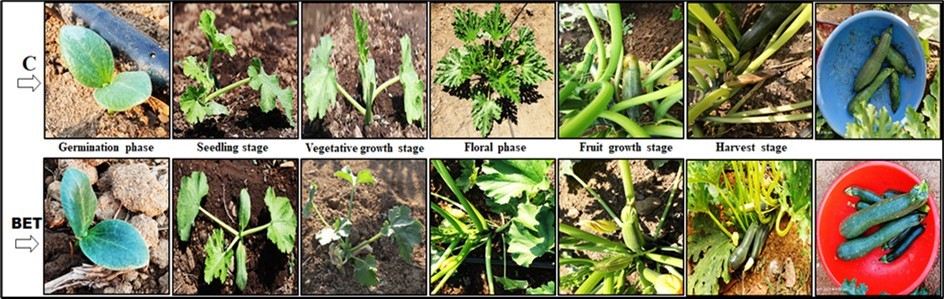
Download figure
Morphological divergence of green zucchini
Green leaf blade colour was observed for CONGZUG, whereas dark green colour was found in BTGZUG. The flower colour of CONGZUG and BTGZUG was yellow and bright yellow, respectively. At harvesting, the colour of the green zucchini fruit was dark green in the BTGZUG group, and CONGZUG had green fruits. The CONGZUG group had light cream seed colour, and the BTGZUG had cream seed colour. The small size and oval shape seeds were found in CONGZUG, and medium and oval shape in BTGZUG. Fruit shape was non-uniformly cylindrical in the CONGZUG, while uniformly cylindrical shape in the BTGZUG.
Fruit skin colour was deep green in the BTGZUG and green in the CONGZUG. Fruit flesh flavour and taste was mild sweet and creamy in the BTGZUG, while mild earthy and nutty in the CONGZUG. Spongy fruit flesh texture was found in the CONGZUG, while less spongy in the BTGZUG. The colour of fruit flesh was white in the BTGZUG and off white in the CONGZUG. Other vegetative traits such as plant leaf size and shape (large and palmately lobed), leaf blade margin (dentate with pointed teeth), number of lobes in the leaf blade (5 lobes), and fruit freshness (green colour, smooth, glossy skin) were observed as similar features in both BTGZUG and CONGZUG (Table 1).
Table 1. Effects of spiritual blessing (biofield) energy treatment (SBET) on qualitative vegetative parameters of green zucchini.| Vegetative trait | Control group (CONGZUG) | Treated group (BTGZUG) |
| Leaf size and shape | Large and palmately lobed | Large and palmately lobed |
| Leaf blade margin | Dentate (pointed teeth) | Dentate (pointed teeth) |
| Leaf blade colour | Green | Dark green |
| Number of lobes in leaf blade | 5 lobes | 5 lobes |
| Flower colour | Yellow | Bright yellow |
| Colour of mature fruit (at harvesting) | Green | Dark green |
| Fruit freshness | Green color, smooth, glossy skin | Green color, smooth, glossy skin |
| Fruit shape | Non-uniform cylindrical | Uniformly cylindrical |
| Fruit skin colour | Green | Deep green |
| Fruit flesh flavour and taste | Mild earthy, and nutty | Mild sweet, and creamy |
| Fruit flesh texture | Spongy | Less spongy |
| Fruit flesh colour | Off white | White |
| Seed colour | Light cream | Cream |
| Seed size and shape | Small and oval | Medium and oval |
Phenology and yield of green zucchini
Compared to the untreated green zucchini group (CONGZUG), biofield energy treated green zucchini group (BTGZUG) exhibited a marked enhancement in both development and morphology. All comparisons were made based on the control group data. Germination rates and plant height improved by 10.14% (p = 0.013) and 35.14% (p ≤ 0.001), respectively. Leaf spreading also showed a significant gain of 21.59% (p = 0.013). Structural architecture was notably robust in the BTGZUG cohort, with primary branching increasing by 41.64% (p = 0.011) and node frequency rising by 23.73% (p = 0.021). Furthermore, indicators of photosynthetic potential were substantially boosted; the total number of leaves per plant surged by 49.01% (p = 0.029), which was further complemented by significant expansions in leaf length (19.09%, p = 0.001) and leaf width (28.15%, p = 0.002).
Compared to the CONGZUG, the treated group (BTGZUG) exhibited a marked enhancement in reproductive priming parameters, with male and female flower counts rising by 44.82% (p ≤ 0.001) and 21.53% (p = 0.018), respectively. The treatment's most profound influence was evident in harvest productivity. Specifically, fruit weight, length, and diameter in the BTGZUG was significantly outperformed than the CONGZUG, showing increments of 24.88% (p ≤0.001), 39.68% (p = 0.002), and 10.36% (p = 0.003). Furthermore, seed count per fruit was substantially higher in the BTGZUG, increasing by 26.94% (p ≤ 0.001). Ultimately, these improvements culminated in a 15.92% surge in total fruit yield (tons per hectare) relative to the control (Table 2).
Table 2. Impact of directed biofield intervention on the phenological development and productivity of Cucurbita pepo (Green Zucchini)| Vegetative trait | Control group (CONGZUG) | Treated group (BTGZUG) | P Value |
| Days to germination | 7-9 | 7-8 | |
| Germination percentage | 89.54 ± 1.45 | 98.62 ± 1.53 | p = 0.013 |
| Plant height (cm) | 53.64 ± 1.24 | 72.49 ± 1.35 | p ≤ 0.001 |
| Spreading of leaves (cm) | 72.07 ± 2.23 | 87.63 ± 2.85 | p = 0.013 |
| Number of primary branches/plants | 6.94 ± 0.48 | 9.83 ± 0.42 | p = 0.011 |
| Number of nodes/plants | 9.61 ± 0.57 | 11.89 ± 0.24 | p = 0.021 |
| Number of leaves per plant | 11.67 ± 1.27 | 17.39 ± 1.15 | p = 0.029 |
| Leaf length (cm) | 21.64 ± 0.42 | 25.77 ± 0.31 | p = 0.001 |
| Leaf width (cm) | 17.48 ± 0.21 | 22.40 ± 0.62 | p = 0.002 |
| Days to first bud initiation | 22.75 ± 0.16 | 22.40 ± 0.31 | p = 0.372 |
| Days to first male flower appearance | 28.24 ± 1.42 | 25.21 ± 1.32 | p = 0.193 |
| Days to first female flower appearance | 33.18 ± 1.43 | 30.13 ± 1.68 | p = 0.239 |
| Days to 50% flowering | 41.24 ± 1.46 | 38.84 ± 1.25 | p = 0.280 |
| Number of male flowers | 8.79 ± 0.45 | 12.73 ± 0.16 | p ≤ 0.001 |
| Number of female flowers | 6.78 ± 0.31 | 8.24 ± 0.21 | p = 0.018 |
| Days to fruit harvest | 46.57 ± 1.67 | 45.74 ± 1.13 | p = 0.702 |
| Fruit weight (g) | 525.47 ± 3.27 | 656.20 ± 2.85 | p ≤ 0.001 |
| Crop duration (days) | 64.58 ± 1.79 | 62.75 ± 1.26 | p = 0.450 |
| Fruit length (cm) | 19.23 ± 0.97 | 26.86 ± 0.33 | p = 0.002 |
| Fruit diameter (cm) | 12.16 ± 0.14 | 13.42 ± 0.13 | p = 0.003 |
| 100-seed weight (gm) | 12.31 ± 0.06 | 12.25 ± 0.02 | p = 0.397 |
| Seed length (cm) | 1.46 ± 0.04 | 1.52 ± 0.02 | p = 0.251 |
| Seed width (cm) | 0.62 ± 0.04 | 0.67 ± 0.02 | p = 0.326 |
| Seed count/fruit | 55.28 ± 0.32 | 70.17 ± 0.35 | p ≤ 0.001 |
| Number of fruits per plant | 4.15 ± 0.17 | 4.77 ± 0.22 | p = 0.090 |
| Fruit yield/plant (kg/plant) | 2.37 ± 0.36 | 3.10 ± 0.07 | p = 0.117 |
| Fruit yield (kg) | 19.29 | 22.37 | - |
| Fruit yield/sq. m plot (kg/sq. m) | 0.80 | 0.93 | - |
| Fruit yield/hectare (ton/ha) | 8.04 | 9.32 | - |
Discussion
Germination and early vegetative vigor was observed significant increased in germination and the substantial surge in plant height within the BTGZUG cohort suggest an acceleration of metabolic pathways associated with early ontogeny. Such enhancements in seed vigor and vertical growth was critical for competitive resource acquisition, as discussed by Rajjou et al. 2012, which highlights how optimized biochemical transitions during germination dictate subsequent seedling fitness 7. The spiritual blessing (biofield) energy treatment (SBET)-Trivedi Effect® appears to have modulated the internal physiological environment of the seeds, potentially influencing hormonal signaling or enzymatic activity that governs early cellular elongation and apical dominance. With respect to structural architecture and branching dynamics a defined characteristic of the BTGZUG group was its robust structural framework, evidenced by a significant increased in primary branching and node frequency. This modification of plant architecture was highly significant, as branching density and node spacing are primary determinants of flower placement and eventual fruit load. According to Wang and Li 2008, described in their comprehensive review 8, the spatial arrangement of organs and the regulation of axillary meristems are pivotal for maximizing a plant's environmental adaptation and reproductive output.
The most striking morphological gains were observed in the photosynthetic apparatus, where the total leaf count was surged, complemented by increases in leaf length and width. This expansion of total leaf area significantly elevates the plant’s light interception capacity and carbon fixation potential. As explored by Gonzalez et al. 2012 9, leaf dimensions are strictly regulated by a coordination of cell proliferation and expansion, both of which appear to have been positively influenced in the BTGZUG group, which might be due to SBET (Trivedi Effect®). Furthermore, the significant gain in leaf spreading ensured that the increased foliar biomass effectively distributed to minimize self-shading, a phenotypic plasticity response discussed by Nicotra et al. 2010 10. The marked enhancement in reproductive priming, characterized by an increase in male flowers and female flowers, indicates a robust stimulation of the plant’s flowering pathways. Such a surge in floral density is often linked to the upregulation of ethylene biosynthesis and hormonal signaling, which are critical for sex expression in cucurbits, as discussed by Martinez et al. 2013 11. This suggests that the treatment might have acted as a priming agent, optimizing the transition from vegetative to reproductive phases.
The treatment's profound influence on fruit dimensions, specifically the significant gains in fruit weight, length, and diameter, which reflects an improved sink strength in the developing fruit. These results align with research explored by Massolo et al. 2019 12. An increased in seed density per fruit in the BTGZUG cohort suggests either a higher rate of ovule fertilization or improved embryo survival. Increased seed count is traditionally a physiological indicator of high pollination success and hormonal stimulus, which often dictates the final size of the fruit, as detailed by Nerson et al. 2000 13. The synergy between increased seed density and fruit weight highlights a highly efficient reproductive cycle within the treated group. Ultimately, the surge in total fruit yield (tons per hectare) demonstrates the practical agricultural value of the treatment effects in maximizing biomass conversion. This level of yield improvement was substantial in competitive horticulture, mirroring the outcomes found in high-tech agricultural interventions designed to boost secondary metabolites and structural integrity, such as those investigated by Scalzo et al. 2005 14.
The significant p-values across all metrics confirm that these enhancements are not stochastic but represent a systemic improvement in the green zucchini's biological performance influenced by SBET (Trivedi Effect®). Collectively, these results indicated that the SBET acted as a potent biostimulant, optimizing the morphology and phenology of green zucchini to support a high-yield physiological state.
Conclusion
The application of the SBET significantly enhances both vegetative and reproductive development, yielding of substantial increases in Green Zucchini plant height, branching, and leaf production. These architectural improvements correlate with superior fruit metrics, specifically increasing fruit length and boosting total yield per hectare. Collectively, the data suggest that the blessing treatment might facilitate robust physiological vigour, effectively translating and increasing biomass into higher agricultural productivity of Green Zucchini. Consequently, this intervention demonstrates high efficacy as a strategy for optimizing crop performance and maximizing harvestable output.
Abbreviations
- SBET
- spiritual blessing energy treatment
- CONGZUG
- control green zucchini group
- BTGZUG
- biofield energy-treated green zucchini group
- SSP
- single super phosphate
- MOP
- muriate of potash
References
- 1.Pandit D L, Yadav D K, Sah B K, Mandal D K, Adhikari N. (2025) Organic fertilizer applications for improved growth and yield of summer squash in Nepal. , International Journal of Agriculture, Forestry and Life Sciences 9(2), 93-103.
- 2.Pandian K, MRAF Mustaffa, Mahalingam G, Paramasivam A, Prince A J et al. (2024) Synergistic conservation approaches for nurturing soil, food security and human health towards sustainable development goals. , Journal of Hazardous Materials Advances 16, 100479-10.
- 3.March D S, Wilkinson T J, Burnell T, Billany R E, Jackson K et al. (2022) The effect of non-pharmacological and pharmacological interventions on measures associated with sarcopenia in end-stage kidney disease: a systematic review and meta-analysis. , Nutrients 14(9), 1817-10.
- 4.Prasad K N, Vinu V, Jois N S. (2024) Application of pranic agriculture to improve growth and yield of banana (Musasp.var.Nanjangud Rasa Bale) - A comparative field trial. , Agricultural Science Digest 44(5), 916-921.
- 5.Torabi S, Taheri M A, Semsarha F, Hamidi A, Hussain M et al. (2026) T-Consciousness fields alter germination, growth, and biochemical responses of wheat (Triticum aestivumcv. Bahar) under drought stress. Plant Signaling and Behavior. 21(1), 2627034-10.
- 6.Richer-de-Forges A C, Arrouays D, Chen S, Dobarco M R, Libohova Z et al. (2022) Hand-feel soil texture and particle-size distribution in central France. relationships and implications. , CATENA 213, 106155-10.
- 7.Rajjou L, Duval M, Gallardo K, Catusse J, Bally J et al. (2012) Seed germination and vigor. , Annual Review of Plant Biology 63, 507-33.
- 8.Wang Y, Li J. (2008) Molecular basis of plant architecture. , Annual Review of Plant Biology 59, 253-279.
- 9.Gonzalez N, Vanhaeren H, Inzé D. (2012) Leaf size control: complex coordination of cell division and expansion. , Trends in Plant Science 17(6), 332-340.
- 10.Nicotra A B, Atkin O K, Bonser S P, Davidson A M, Finnegan E J et al. (2010) Plant phenotypic plasticity in a changing climate. , Trends Plant Science 15(12), 684-92.
- 11.Martínez C, Manzano S, Megías Z, Garrido D, Picó B et al. (2013) Involvement of ethylene biosynthesis and signalling in fruit set and early fruit development in zucchini squash (Cucurbita pepoL.). , BMC Plant Biology 13, 139-10.
- 12.Massolo J F, Zarauza J M, Hasperué J H, Rodoni L M, Vicente A R. (2019) Maturity at harvest and postharvest quality of summer squash. Pesquisa Agropecuária Brasileira. 54-00133.